
Finding "sense" in the Common Minimum Programme of the United Progressive Alliance government, the World Bank on Thursday said India could at least grow by 6 per cent over the long term, but containing fiscal deficit was important.

The grouping of Brazil, Russia, India, China and South Africa had in March decided to establish a new development bank -- BRICS Bank -- to finance infrastructure projects and to create a $100 billion contingency fund to tackle any financial crisis in emerging economies.

The Enforcement Directorate (ED) and Income Tax (I-T) Department are likely to join the Assam Police in investigating alleged organised financial crimes and acquisition of benami properties by event manager Shyamkanu Mahanta, an accused in the death of Assam's cultural icon Zubeen Garg.
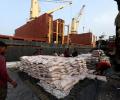
Apex exporters body FIEO on Tuesday expressed serious concerns over high US tariffs on Indian goods and said that textiles and apparel manufacturers in Tirupur, Noida, and Surat have halted production amid worsening cost competitiveness due to these steep duties. The US duties on Indian goods will increase to 50 per cent from August 27.
In its global economic forecast update for 2009, the World Bank projected a growth rate of 4 per cent for India during 2009-10, while the ADB, in its outlook, expects the economy to expand by 5 per cent. A separate outlook by the Organisation for Economic Cooperation and Development, a club of developed countries, has forecast a 4.3 per cent growth rate for India. India had last grown below this level in 2002-03, when the economy expanded by 3.8 per cent.

After sinking 586 points during the day, the 30-share index ended 503.62 points, or 1.29 per cent, lower at 38,593.52. The broader NSE Nifty plunged 148 points, or 1.28 per cent, to 11,440.20.
Amid criticism over engaging experts from multilateral agencies like World Bank, Planning Commission on Wednesday asserted that none of the "outside bodies"
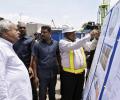
The metro, it seems, is politics-proof -- even if it comes at a high cost.
Take the Rediff Business Quiz and see how much you know about the Asian Development Bank.
New-generation Yes Bank is in talks with Asian Development Bank for Rs 100 crore (Rs 1 billion) debt.

'India is a big market for StanC, and it is also fastest growing economy in the world.'

Kv Kamath has big plans as BRICS Bank chief.

K V Kamath to take charge of BRICS Bank in July.
In the face of burgeoning forex reserves at over $93 billion, the government has quietly prepaid $1.4 billion worth of costly foreign loans to World Bank and Asian Development Bank.

Stock markets snapped the four-day falling streak on Tuesday with the benchmark Sensex rebounding by 317 points on buying in auto and pharma shares amid a decline in retail inflation to a more than six-year low, nearing the RBI's comfort zone. The 30-share BSE Sensex climbed 317.45 points or 0.39 per cent to settle at 82,570.91. During the day, it jumped 490.16 points or 0.59 per cent to 82,743.62. The 50-share NSE Nifty edged higher by 113.50 points or 0.45 per cent to 25,195.80.

In trade negotiations, as in chess, sometimes you need to accept a temporary disadvantage to secure a better long-term position, points out Sonal Varma, chief economist (India and Asia ex-Japan) at Nomura.

From the Sensex firms, Mahindra & Mahindra, HCL Tech, Tata Motors, Nestle, ITC, Hindustan Unilever, Larsen & Toubro, and Tech Mahindra were the biggest gainers. In contrast, Eternal, UltraTech Cement, Power Grid, Tata Steel and Kotak Mahindra Bank were among the laggards. Eternal dropped 4.51 per cent.

'These efforts by Beijing can be weaponised one day with economic, security and political implications for India.'

The Asian Development Bank (ADB) has approved $700 million in loans to support the Indian government's efforts to accelerate investment in infrastructure which the country requires to ensure strong economic growth.
Global agencies have shown interest in Bihar's developmental projects. They met Bihar CM Nitish Kumar to chart out an investment plan.
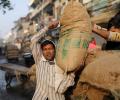
India's economic growth forecast for 2025 has been revised downward to 6.3 per cent, and despite a projected moderation, the country remains one of the fastest-growing large economies, supported by resilient consumption and government spending, the United Nations has said.

Indian growth in the rest of this fiscal year and next will be propelled by robust domestic consumption as consumer confidence improves, and by investment, including large increases in government capital expenditure, according to the Asian Development Outlook September 2023. "As slowing exports could foment headwinds for the economy, and erratic rainfall patterns are likely to undermine agricultural output, the growth forecast for FY2023 is revised down marginally to 6.3 per cent," ADB said.
Need to lower fiscal deficit and get GST implemented rolling.
Besides him, Brajendra Navnit who served in the Prime Minister's Office (PMO) has been appointed as Ambassador and Permanent Representative of India to the World Trade Organisation (WTO), Geneva, Switzerland. Topno is a 1996 batch Indian Administrative Service officer of Gujarat cadre.

ADB, which came out with a Special Note on economies, however, kept the projections for India and China unchanged 8.2 per cent and 9.6 per cent, respectively.
Most south Asian nations will fall short on the Millennium Development Goals, a set of eight globally agreed development goals due to be achieved by 2015, a study by the World Bank and International Monetary Fund said.The report has warned that developing countries stand to suffer the most from climate change and the degradation of natural resources.

"The Asian Development Bank will provide India up to 700 million dollar in loans to accelerate its roll-out of infrastructure projects through public-private partnership initiatives."

Assistance would be given to Small Industries Development Bank of India and its partner micro finance institutions to review and revise their gender policies and practices.

Finance Minister Arun Jaitley has been appointed on the Board of Governors of Philippines-based Asian Development Bank (ADB).

The crisis may not be as visible this time, but the stakes are just as high, points out Rajeswari Sengupta.

Titan Company, Axis Bank, NTPC, Tata Motors, ITC, Tech Mahindra, Bajaj Finserv, ICICI Bank, HDFC Bank and Bajaj Finance were the other laggards. Bharti Airtel, Power Grid, Infosys and Larsen & Toubro were among the gainers.

'With a solid investment programme and sustainable development strategy, India can exceed 7 per cent growth per year, or a doubling of high-quality national income within a decade.'

Fitch Ratings on Tuesday raised India's growth forecast for the current fiscal to 7.2 per cent, from 7 per cent projected in March, saying elevated consumer confidence will drive spending, besides increased investments. In June update to its global economic outlook report, Fitch said it expects inflation to decline to 4.5 per cent by end of this year and RBI to cut policy interest rates by 25 basis points to 6.25 per cent.

Sun Pharma, Tata Steel, State Bank of India, Axis Bank, Tata Motors, Larsen & Toubro and ICICI Bank were also among the Sensex gainers. HCL Tech, UltraTech Cement, Nestle and Hindustan Unilever were among the laggards.

Among Sensex shares, Mahindra & Mahindra, Bharti Airtel, Bajaj Finance, Zomato, Nestle, Bajaj Finserv, Maruti and Titan were the biggest gainers. Sun Pharma, Power Grid, Tata Consultancy Services, Tech Mahindra, Asian Paints and Tata Motors were among the laggards.
